

Quick facts by PokerStrategy
- Early position is the position that gets to act first in a round of betting.
- First to act is a disadvantage, and hence, a tighter hand selection is required.
- Position is the key to optimal strategy.
- Early position strategy varies in cash games and tournaments.
- Misplaying an early position can lead to heavy chip loss.
What Is Early Position in Poker?
In poker, “early position” (EP) refers to the position that must act first in each round of betting. They are the seats to the immediate left of the big blind and are the Under the Gun (UTG) seats. Being seated in these positions is a disadvantage because they must act before they know what the next players are doing.
When we discuss what an early position in poker is, these are the positions that give you the minimum amount of information. Because you need to make a decision on whether to call, raise, or fold before most of your opponents, you’re at a greater risk of committing to better hands or multi-way pots.
This imposes a need for a much shorter range of initial hands compared to the middle or late position.
Early Position Explained
Early position, or early play, in poker matters because initial action is less adaptable and less informative. An individual opening from UTG is opening blind to what the remainder of the table is going to do. This will make it more probable to have better hands in front and less probable for bluffs to succeed.
The consequences are apparent:
- Decreased chance to bluff successfully.
- More risk of facing reraises.
- More likely to play out of position post-flop.
- More accurate pre-flop hand range is needed.
Due to these limitations, playing from an early position requires a highly disciplined and conservative approach. You must play only very good hands and be prepared to fold weaker hands that you would be likely to play in different poker seat positions.
Poker Positions at the Table
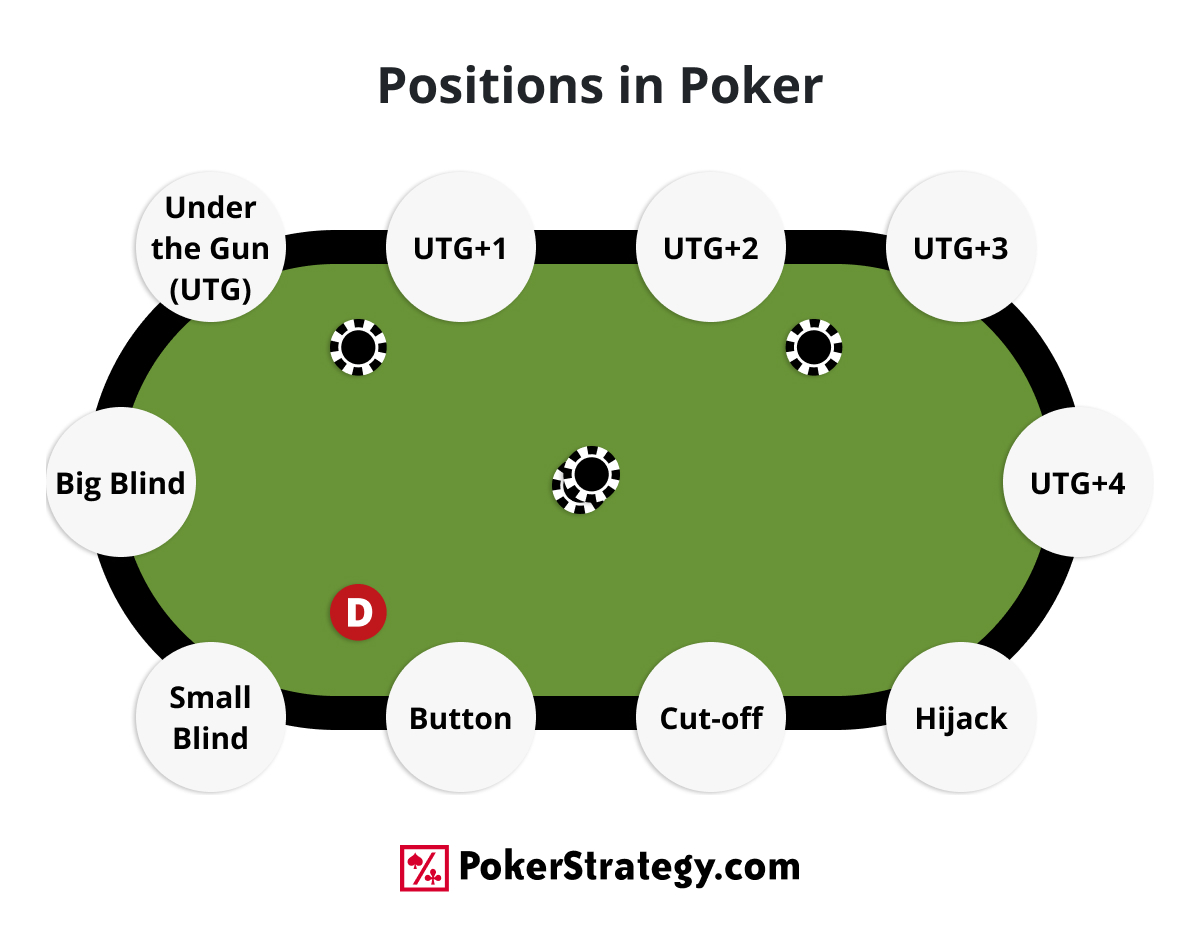
Learning about early position in poker requires understanding it within the full context of poker table positions, which typically range from 6 to 10 players.
They are normally categorized like this:
Early Position (EP)
- UTG (Under the Gun)
- UTG+1 (in 9-10 handed games)
Middle Position (MP)
- MP1, MP2 (varies by table size)
Late Position (LP)
- Hijack
- Cutoff
- Button (Dealer)
Blinds
- Small Blind (SB)
- Big Blind (BB)
Each position changes clockwise after every hand, allowing every player to go through each seat.
Standard Early Position Seats
The number of early position seats depends on the number of players at the table:
- 6-Max Table: UTG alone is still an early position.
- 9-Max Table: UTG and UTG+1 are the early position seats.
- 10-Max Table: UTG, UTG+1, and sometimes UTG+2 are early.
Here’s how these correspond:
- UTG (Under the Gun): Always the first to act pre-flop.
- UTG+1: Second to act pre-flop and still considered EP.
- UTG+2: Only available in EP for 10-player full-ring games.
It’s important to know which seats constitute an early position when developing winning strategies.
Early Position Strategy in Poker
A solid early position poker strategy is based on tight, value-based play.
Since EP players must act on limited information, they should:
- Begin with only the top hands: AA–JJ, AKs, AKo, and occasionally TT or AQs.
- Avoid speculative hands: Suited connectors, small pairs, and unsuited broadways are weaker from EP.
- Be willing to fold to aggression: 3-betting from out of position must be a warning sign unless you are holding a high-end hand.
- Minimize bluffing: Bluffing or semi-bluffing without knowledge is much riskier from an early position.
Also, it’s better not to open-limp (simply call the big blind) in EP, since it invites a large number of callers and leads to complex post-flop situations.
How to Adjust Early Position Strategy in Tournaments vs Cash Games
As with virtually any aspect of poker, how you apply strategies will depend on the type of game. Cash games and tournaments invariably require different approaches throughout almost the entire event.
Cash Games
- Stack Depth: The deeper stacks permit further post-flop maneuvering, yet tight opening ranges are still necessary early in position.
- Implied Odds: Speculative hands (suited Aces or medium pairs, for instance) are occasionally playable when there are passive opponents who will pay off big hands.
- Aggression: While it is especially important in cash games, players in EP still need to exhibit controlled aggression.
Tournaments
- Stack Preservation: Lost chips are gone for good; therefore, play from EP has to be tighter.
- ICM (Independent Chip Model): Payoff implications render survival more valuable and contribute to the risk inherent in loose early-position play.
- Dynamics that change: As the stacks decrease, hands like 99 or AQ can become automatic shoves by EP in later phases.
Players must remain aware of the different incentives and risks in each building so that they can adjust their early position plays accordingly.
Common Errors in Early Position
Some of the most frequent errors from EP are:
- Opening too wide: Playing too many hands, especially speculative or dominated hands.
- Limping: Inviting trouble by not opening with playable hands.
- Re-raising calling without a strategy: Flatting 3-bets out of position with marginal hands.
- Overlooking table dynamics: Not adjusting according to opponent patterns or stack sizes.
Avoiding these mistakes is the secret to sustaining profitability from the weakest seats at the table.
Early Position vs Late Position
Comparing early vs late position highlights the contrast in strategic advantage:
| Feature | Early Position | Late Position |
|---|---|---|
| Action Order | First | Last |
| Range Tightness | Very tight | Much wider |
| Information Available | Least | Most |
| Bluffing Success | Lower | Higher |
| Control Over Pot | Less | More |
Late position players are favored to observe opposing players’ moves to enable easy decision-making, more profitable steals, and wider value bet opportunities. Poker early position, by contrast, demands conservative, value bet play due to the positional handicaps.
Early Position Strategy in Online Poker
Online poker adds extra complexity to playing in early position:
- Harder competition: Competition on the Internet is technically better, making loose play from early positions even less profitable.
- Data and HUDs: Opponents prefer monitoring figures. EP openings must stay constant to prevent exploitation.
- Faster speed: All players multitable, therefore an EP strategy needs to be decided in advance.
- Smaller edges: With online play more optimised, mistakes in the early position cost more.
It’s crucial to play a data-driven, range-based game in the early position of online poker games on reputable poker sites. Playing from an early position reduces losses and increases profits in the long term, especially in organized environments such as cash games, tournaments, and online poker.
Frequently Asked Questions
What is a late position in poker?
Late position refers to seats that play last in a round of betting. Most commonly, they include the Button, Cutoff, and sometimes the Hijack. They provide the most information and strategic freedom.
What hands do I play in early position?
Play your strong hands such as AA, KK, QQ, AK, and AQ. There are certain systems that entail playing JJ, TT, and suited broadways depending on the table dynamics.
Are blinds in early position?
No, blinds (Small Blind and Big Blind) are not in the early position. However, they do get to act early after the flop and therefore have the same disadvantages.