

Quick facts by PokerStrategy
- Fold equity is the chance that opponents will fold when you make a bet or raise.
- It can be expressed as a percentage, chip, or cash value.
- Fold equity is important when making bluffs or semi-bluffs.
- You can combine fold equity with hand equity to work out your total equity in the pot when making a bet.
What Is Fold Equity in Poker?
Fold equity in poker is the additional equity gained from the chance that opponents will fold to a bet or raise. Fold equity is expressed as a percentage and can also be used to give a chip or cash value.
Any time other players fold to your bet, you win the pot regardless of whether you had the strongest poker hand.
Of course, opponents won’t fold every time you make a bet. Rather, they will be forced to fold the weaker portion of their range and call with the stronger portion. You gain fold equity based on how often you expect other players to fold.
Here, we’ll take a look at poker fold equity meanings, calculation, and strategy.
Poker Fold Equity Importance
You can’t always rely on having the best hand to win the pot, as doing so would leave you with no edge over the table. Betting with a weak hand or draw gives you an additional way to win the pot; you can take it down right there and then when other players fold.
Fold equity is crucial for poker strategy whenever you are betting with anything less than a very strong value hand, such as when you are bluffing or semi-bluffing.
Even when you have the best hand, getting opponents to fold is often a positive result, as you deny other players their share of the pot.
Fold equity is the theoretical concept behind bluffing. Without it, it would be difficult to determine whether a bluff is profitable or not.
Fold Equity Strategy in Action
Now that we’ve answered the question of what does fold equity mean in poker, it’s time to move on to practical tips on how to use fold equity when making bluffs or semi-bluffs.
Required Fold Equity According to Bet Sizing
When it comes to fold equity, bet sizing is important. For your bluffs to be successful, you’ll need to strike a balance between betting big enough to gain some fold equity, while not risking too much to win the pot.
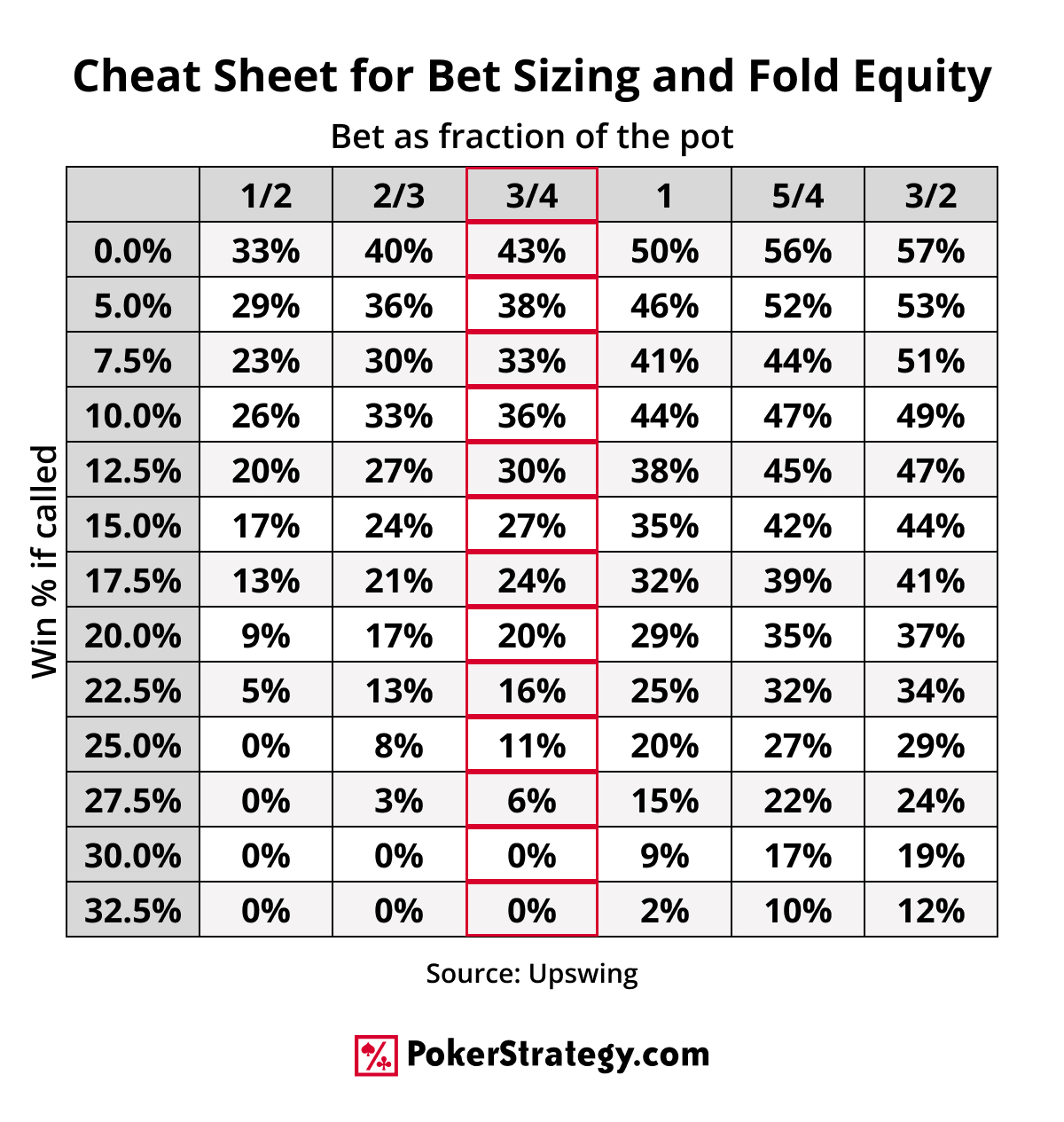
The bigger your bet sizing, and the less equity you have in the hand, the more fold equity you’ll need for the bet to be profitable.
Here’s a cheat sheet that shows you the required amount of fold equity you’ll need depending on the bet sizing you use and your hand equity. You can also use a fold equity calculator to do the sums:
Maximizing Fold Equity in Poker
In order to maximize your fold equity in poker, you’ll need to make sure your bets are well-timed and effectively executed:
- Represent Hands: You’ll gain more fold equity if your bluff is credible and represents a strong hand that is within your range and misses your opponent’s range. This is also known as the range advantage.
- Board Texture: You’ll generally have more fold equity on a dry board, as there are less hands that other players can call or raise with compared to a very draw-heavy board.
- Position: When in position, you will be able to take the last aggressive action in the pot after seeing others act first. This gives you a huge advantage and more chances to gain fold equity throughout the hand.
- Opponent Type: Some opponents won’t fold unless they have completely missed the board. Others will call with pretty much anything. You’ll get the most fold equity against tight players who are reluctant to commit chips.
- Stack Sizes: It’s not just pot odds and bet sizing that will deter other players from calling, but also the amount of pressure you can apply by betting. If your bet costs a chunk of your opponent’s stack or you move all in, this will generate even more fold equity.
- Pressure Points: At certain moments in a poker tournament, the pressure is increased, and ICM becomes relevant. Players are not incentivised to call wide during the bubble or before pay jumps. This is the perfect time to maximize fold equity by betting or raising, especially if you have a big stack.
How to Calculate Fold Equity
The simplest fold equity calculation is to work out your opponent’s likelihood of folding (as a percentage), then multiply that by the current pot size to determine the chip or cash value of your fold equity:
Chance Opponent Folds x Pot Size = Fold Equity
For example, let’s say the pot is $100 and you make a bet. Based on your opponent’s current range, you expect that they will fold around 50 percent of the time. This gives you fold equity of 50 percent, which is worth $50 given the pot size.
This is a basic but useful way of thinking about fold equity, especially when you have zero percent equity in the hand and are purely bluffing.
The most difficult aspect of calculating fold equity is estimating how often other players will fold. To work out an opponent’s fold percentage, you’ll need to use your hand reading skills to gauge their range of possible hand combinations and then figure out how many of these combinations they are likely to fold when you bet.
To do this, you can analyze board texture, the action so far, the opponent’s tendencies, and so on. These are skills you will develop as you become more proficient at poker, especially when playing frequently on online poker sites, where hand volume sharpens your ability to read opponents and recognize patterns.
Fold Equity vs Pot Equity
Hand equity is the amount of equity you have based on the strength of your hand against your opponent’s range. For example, if you have pocket aces versus pocket deuces preflop, you have 80 percent hand equity. In other words, you are expected to win 80 percent of the time.
Fold equity, as we’ve discussed, is the additional equity that you gain by betting when there’s a chance your opponent will fold and forfeit the pot.
Your total equity in the pot is a combination of your hand equity and fold equity. The more hand equity you have, the less fold equity you’ll need to profitably bet. Likewise, the more fold equity you have, the less hand equity you’ll need.
Fold Equity With a Pure Bluff
If you are running a pure bluff, this means you have little or no hand equity, meaning you’ll almost certainly lose if the hand makes it to showdown. In this case, your only equity in the pot is any fold equity that you can gain from betting or raising.
Pure bluff example:
- Player A: T♥ 9♥
- Player B: K♦ J♠
- Board: J♣ 8♥ 5♥ 2♣ A♣
Player A had a huge draw on the flop but missed and now has ten-high on the river. They will almost certainly lose at showdown and so have zero hand equity. Player A decides to bluff on the river to gain fold equity and a chance to win the hand by bluffing. If Player A makes a pot-sized bet, they will need 50 percent fold equity to make the bet a break-even proposition.
Betting With Hand Equity
Unless you have absolute air and are pure bluffing, you’ll typically have at least some hand equity.
For example:
If you make a three-bet shove preflop with a suited connector as a bluff, you’ll still have 20 percent hand equity even against overpairs and likely have closer to 40 percent equity against a typical calling range.
Similarly, if you have a flush draw on the flop, you’ll have around 35 percent equity against top pair because you’ll win the hand the times that you hit the flush.
Making a bet or raise when you have some hand equity can potentially increase your total profits because you will gain additional fold equity.
This gives you two ways to win the pot. You can either hit and realize your hand equity, or force your opponents to fold and realize your fold equity. Your total equity in the pot is therefore a combination of the two.
Combining Hand Equity and Fold Equity
To figure out our total equity in a hand, we’ll need to work with a slightly more complex formula for fold equity, one that takes into account how much equity you actually gain by getting opponents to fold.
Here’s the formula:
Chance of Fold * Opponent’s Hand Equity = Fold Equity
We again calculate the chance that opponents will fold based on their current range. This time, though, you’ll multiply this by your opponent’s hand equity.
For example:
You have a flush draw with 35 percent equity. Your opponent is therefore ahead with 65 percent hand equity. You predict that they will fold to your bet around 50 percent of the time, so that you will deny them 50 percent of their 65 percent equity.
Fold Equity = 50%*65% = 32.5%
You gain 32.5 percent in fold equity by making this bet, which you can then add to your hand equity to work out your total equity in the pot.
Hand Equity + Fold Equity = Total Equity
In our example, this gives you the following:
35% + 32.5% = 67.5% Total Equity
Common Mistakes With Fold Equity
Here are some common mistakes players make when it comes to knowing how and when to use fold equity:
- Misreading Opponent’s Hand Strength: Opponents won’t fold if they have a solid value hand, so you’ll be bleeding chips by betting big in an attempt to maximize fold equity. There needs to be a good chance that other players will fold when you bluff.
- Poor Bet Sizing: Using a bet sizing that is too small will allow opponents to call with most of their range and won’t generate enough fold equity. Go too big and you could risk too much of your stack when other players have a strong hand to call with.
- Ignoring Opponent Type: Bluffing too liberally against loose players or calling stations is a mistake, as they won’t fold often enough to make your bets profitable.
- Zero Equity Bluffs: Zero equity bluffs are much riskier because you are relying completely on fold equity to win the hand. Be careful when making these bets. It’s much safer to semi-bluff or bet with equity.
Frequently Asked Questions
What is the fold percentage in poker?
Fold percentage is the percentage of the time that opponents are expected to fold to a bet. For example, if you expect another player to fold out half of their range, the fold percentage is 50 percent.
Why would you fold instead of check?
If an opponent has already made a bet or raise, you won’t have the option to check. You’ll have to at least match the current bet. If you don’t want to match the bet, you can fold your cards to forfeit the pot.
How does fold equity work in online poker tournaments?
Fold equity is very important in online poker tournaments. By betting or raising, you get opponents to fold a percentage of your range, which improves your overall chances of winning the pot. Gaining fold equity increases your overall equity in the hand.