

Quick facts by PokerStrategy
- A pair in poker is a hand that includes two cards of the same rank.
- You can make a pair using either one hole card and one board card, or both hole cards, known as a pocket pair.
- Strong top pair or overpair hands are played for value.
- Low pairs are only useful for set mining or bluff catching.
What Is a Pair in Poker?
A pair in poker is a hand that contains two cards of the same rank. The other three cards are of different ranks and don’t match the pair. The three unmatched cards are known as kickers.
You can make a pair in poker by either matching one of your hole cards with a card on the board or by being dealt two cards of the same rank. A pair made using both hole cards is known as a pocket pair.
Example of a pair using board cards:
- Player A: A♣K♠
- Board: A♦8♠2♣
Example of a pocket pair:
- Player B: A♣A♦
These are the two types of pairs in poker, and both have the same ranking. The difference is how they are made.
In both live games and online poker rooms, pairs are among the most common made hands, especially in Texas Hold’em.
How One Pair Ranks
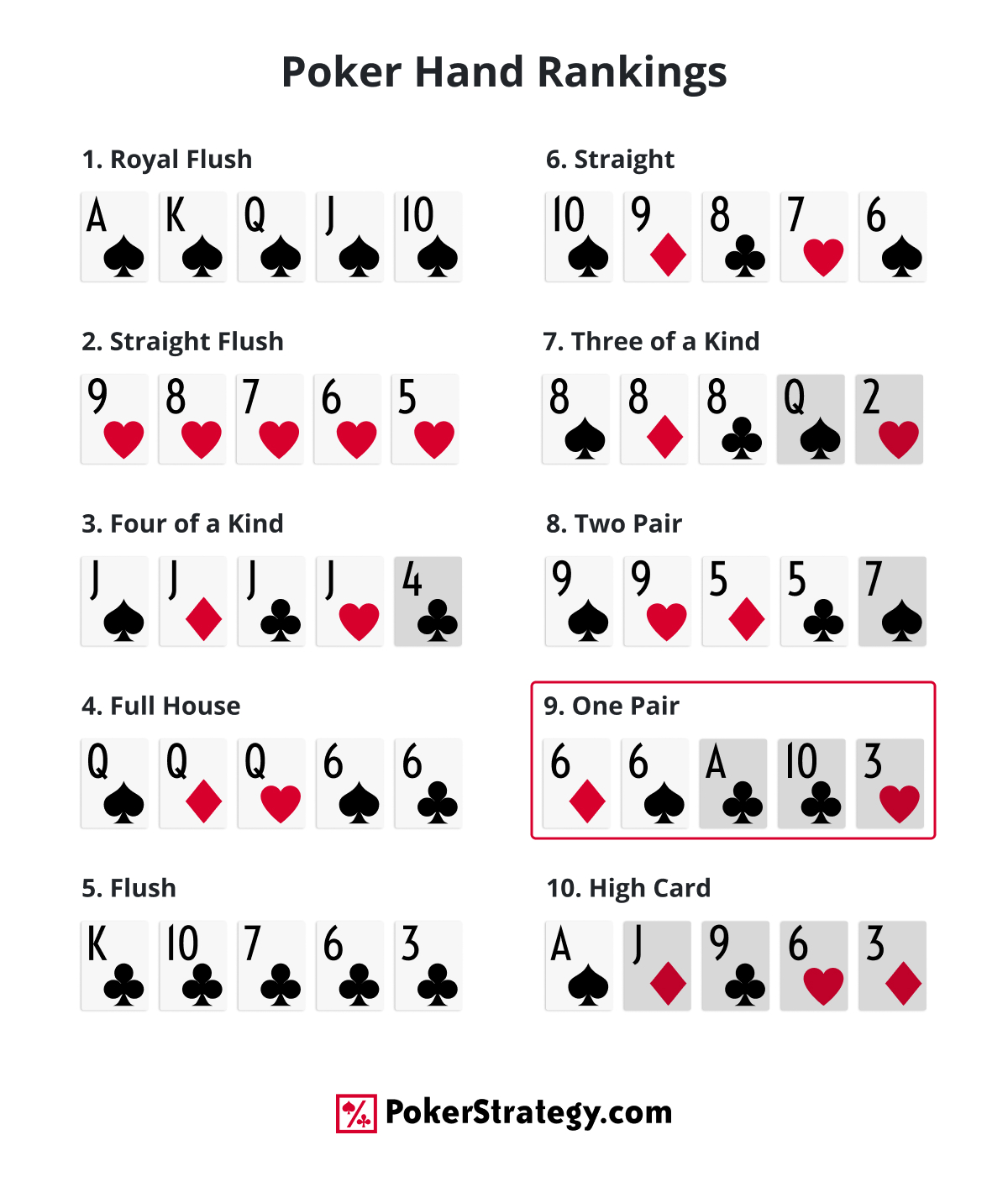
A pair is the second from lowest ranked poker hand, above high card, and directly below two pair. A pair versus high card wins, but a pair loses to all other hands, as shown in the chart below:
How to Play a Pair in Texas Hold’em
Even though a pair is not ranked highly, it is a common hand that can be enough to win the pot. This is especially true on real money poker apps, where games run fast and players often misplay hands like one pair. The key is knowing when to bet, when to control the size of the pot, and when to fold.
Strong Pairs vs Weak Pairs
The way you’ll play a pair in poker depends on its strength. There’s a huge difference between playing a pair of aces with top kicker, which is a value hand that is often ahead, compared to playing bottom pair, which is nothing but a bluff catcher:
- Top Pair, Top Kicker: Top pair with top kicker is a strong hand that can win at showdown. You’ll often want to bet for value, targeting opponents who have a lower pair or the same pair with a lower kicker.
- Top Pair, Weak Kicker: Top pair with a weak kicker is a vulnerable hand because you can end up losing big pots against players who have you dominated with a higher kicker. Pot control is key. Aim to make a showdown for cheap. If the betting heats up, be prepared to fold.
- Second Pair: There’s a chance you’re ahead on the flop with second pair, so you’ll need to decide between betting to protect your hand or checking back to control the pot. If the action picks up on the turn and river, your hand essentially becomes a bluff catcher.
- Third Pair or Worse: With bottom pair, you are rarely going to be calling down bets, which means it’s going to be difficult to make it to showdown. It’s likely you’re beat if opponents start betting, so third pair or worse is nothing but a bluff catcher.
Playing Pocket Pairs in Poker
Pocket pairs like aces and kings are the best starting hands in Texas Hold’em.
Low pocket pairs are primarily useful for set mining. Medium pocket pairs, such as nines and tens, can be challenging to play, especially when overcards appear on the board.
For a detailed guide on playing pocket pairs, see our Pocket Pair Strategy Guide.
Pair Strategy Tips in Poker
- Play premium pocket pairs and top pair with top kicker as value hands. Bet or raise early in the pot to protect against draws.
- Use small pocket pairs to set mine. Be prepared to fold out any low pair hands against overcards on the board.
- With medium strength pairs, use pot control by checking and flat calling small bets with the intention of making it to showdown without committing too much of your stack.
- Avoid slowplaying one pair hands; they are too vulnerable. The only exception is when you have a very strong pair, stacks are shallow, and there’s a decent chance your opponent will commit their chips on the next street.
- Treat weak pairs as bluff catchers. Even then, don’t overuse small pairs to catch bluffs.
Pair in Poker Examples
Below are examples of a pair in poker. Hand one is a strong pair that is played for value, whereas Hand 2 is a weaker pair that is played using pot control:
Hand 1: Top Pair for Value
- Player A: A♦Q♦
- Player B: J♣T♣
- Board: Q♣J♥6♥
Player A raises preflop and Player B calls in the big blind. Player B check, and Player A makes a continuation bet for value with top pair. Player B calls with the second pair.
Hand 2: Pot Control with Middle Pair
- Player A: Q♥J♥
- Player B: K♠9♠
- Board: K♥J♠3♣3♦7♥
Player A raises preflop, and Player B calls in the big blind. Player B checks, and Player A decides to check behind with the second pair, controlling the size of the pot. Player A ends up calling the turn bet, then both players check the river, so Player A loses the minimum.
Odds of Getting a Pair in Poker
The odds of being dealt any pocket pair in poker are around 5.88 percent. That’s an average of once every 17 hands.
With unpaired hole cards, the odds of pairing either one on the flop is around 32.43 percent, a little less than once every three hands. The chances of pairing at least one by the river is 50.7 percent, although you won’t always get to see the river if you miss the flop.
Common Mistakes When Playing a Pair
Here are the most common mistakes that players make with pairs:
- Overvaluing Weak Pairs: Low pairs are easily beaten and are at risk when any overcard falls on the board. Likewise, high pairs with weak kickers can run into trouble against higher kickers. Overvaluing these kind of hands is a costly mistake.
- Playing Passively on the Flop: Strong pairs with decent kickers are often ahead on the flop. That’s the time to bet for value against weaker pairs. Checking on the flop misses value and gives opponents a chance to catch up.
- Ignoring Board Texture: Strong one pair hands play well on dry boards when you can target weaker pairs. The trouble usually comes on draw heavy boards that allow opponents to make straights, flushes, or huge combos. Don’t ignore board texture and know when to fold if the turn or river completes draws.
Frequently Asked Questions
How many types of pairs are there in poker?
It’s possible to make a pair with any of the cards in the deck, from a pair of deuces up to a pair of aces. You can also make two pair in poker.
What is the lowest pair you can get in poker?
The lowest pair you can make in poker is a pair of twos, known as deuces.
What beats a pair in poker?
A pair is beaten by any two pair, three of a kind, straight, flush, full house, four of a kind, straight flush, and royal flush.
Can you have three pairs in poker?
Poker hands are made using five cards, so you can only make a maximum of two pair. Three pair is not possible under standard poker rules.
Is one pair a good hand?
One pair can be a winning hand in Texas Hold’em poker, especially a strong top pair or premium pocket pair. However, one pair is easily beaten and tends to be vulnerable on later streets, especially on draw heavy boards.
What if two players have the same pair?
If two players have the same pair, the player’s other cards, known as “kickers”, are used to decide the outcome. Whoever has the highest kicker wins the pot.
How does a kicker work with a pair?
If two or more players have the same value pair, the other cards, known as kickers, are used as a deciding factor. Whoever has the highest kicker wins the pot.