

In This Guide
Quick Facts by PokerStrategy
- Poker is a family of card games played with a standard 52-card deck.
- The goal is to make the best five-card hand or get opponents to fold.
- It’s played in casinos, at home, and in online poker rooms worldwide.
- The game combines chance, skill, strategy and psychological warfare.
What Is Poker?
Poker is a family of card games that combine betting, strategy, and psychology.
Unlike many casino games, poker is not only about the cards you’re dealt. Table position, betting patterns, and reading your opponents all play a huge role. This mix of skill and luck is what makes the game both challenging and exciting.
If you’re wondering what poker is and how it is played, the structure is simple: players receive cards, place bets in rounds, and the best five-card hand wins the pot.
The Origins & History of Poker
Now that you know the basic meaning of poker, it’s easier to see how the game evolved.
The exact answer to when poker was invented is debated, but most historians trace the game back to the early 1800s in the US, with influences from older European card games. By the mid-1800s, poker was spreading along the Mississippi River, often played in saloons with a 20-card deck before the 52-card deck became standard.
In the 1970s, Texas Hold’em rose to prominence thanks to the World Series of Poker (WSOP).
By the 2000s, online poker had triggered a global boom, making household names of pros and turning casual players, such as Chris Moneymaker, into millionaires. Many of those names, as well as up-and-coming stars, routinely find themselves subjects of popular poker news.
Poker Card Values
Understanding the origins of poker provides context, but to actually play, you need to know the cards themselves. As mentioned previously, poker uses a standard 52-card deck without jokers.
The suits (hearts, clubs, spades, diamonds) are equal in strength. Card values run from 2 (lowest) to Ace (highest). Aces can also count low in straights (A-2-3-4-5), which players call the wheel.
Poker Hand Rankings
Once you understand the card values, the next step is to comprehend how they combine to form winning poker hands. The strength of your hand decides who wins at showdown.
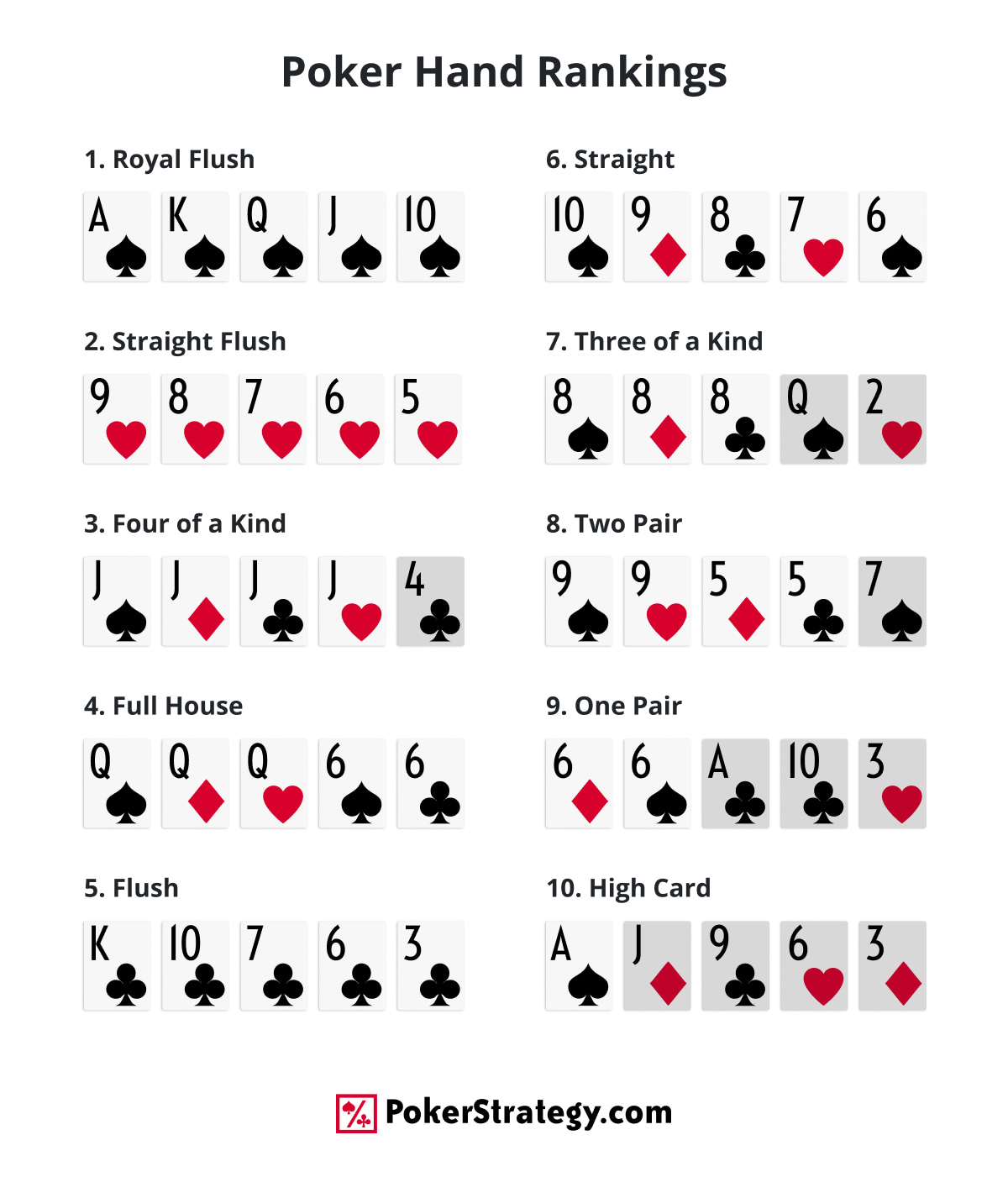
Below are poker hands in order from strongest to weakest:
- Royal Flush: A-K-Q-J-10 of the same suit.
- Straight Flush: Five consecutive cards of the same suit.
- Four of a Kind: Four cards of the same rank.
- Full House: Three of a kind + a pair.
- Flush: Five cards of the same suit.
- Straight: Five consecutive cards, mixed suits.
- Three of a Kind: Three cards of the same rank (i.e., 3-3-3 or K-K-K).
- Two Pair: Two pairs of matching ranks (i.e., 3-3 and K-K or 6-6 and A-A, with any fifth card).
- One Pair: Two cards of the same rank with three unrelated cards (i.e., 3-3-x-x-x or K-K-x-x-x).
- High Card: No match among any of your cards. It’s possible to win a hand, for example, with a K if no one has a made hand or an Ace.
Types of Poker Games
Poker comes in several forms, but most variants fall into four main categories:
Community Card Games
Players share the same face-up cards dealt in the middle of the table. Each of the players supplements the “community cards” with their own concealed hole cards to make the toughest imaginable hand.
- The most popular variant is Texas Hold’em, played worldwide both live and online.
- Another major variant is Omaha, where players receive four hole cards instead of two, creating more potential for strong hands.
Stud Games
Another popular style is stud, in which players hold a combination of face-up and face-down cards over several rounds of betting. No community cards are used, and each player’s board develops individually.
- Examples include Seven Card Stud, the leading poker format before Hold’em became popular, and Razz, the lowball game in which the lowest poker hand wins the pot.
Draw Games
A third category is draw games, which allow players to discard and replace some of their cards in hopes of improving their hand. Here, all the participants start with a full hand of private cards, followed by rounds of drawing and betting.
The most well-known variant is Five Card Draw, a simple yet strategic template that was formerly the foundation of home games and is today widely used to teach beginners.
Mixed Games
These are formats in which multiple variants rotate during a single session or poker tournament, combining several poker variations into a single event.
A typical example is HORSE, which rotates through five game varieties: Hold’em, Omaha Hi-Lo, Razz, Seven Card Stud, and Seven Card Stud Eight-or-Better (Stud Hi-Lo).
It takes versatility for poker players to be successful at more than one variant, thus making HORSE the ultimate all-around poker test and popular choice for higher-stakes mixed-game tournaments.
Popular Poker Variants
Each poker variant follows the same core principles but differs in card distribution, betting structure, and strategy.
Texas Hold’em Poker
This is inarguably the most popular poker game worldwide.
Learning the rules of Texas Hold’em isn’t difficult, but mastering the game is:
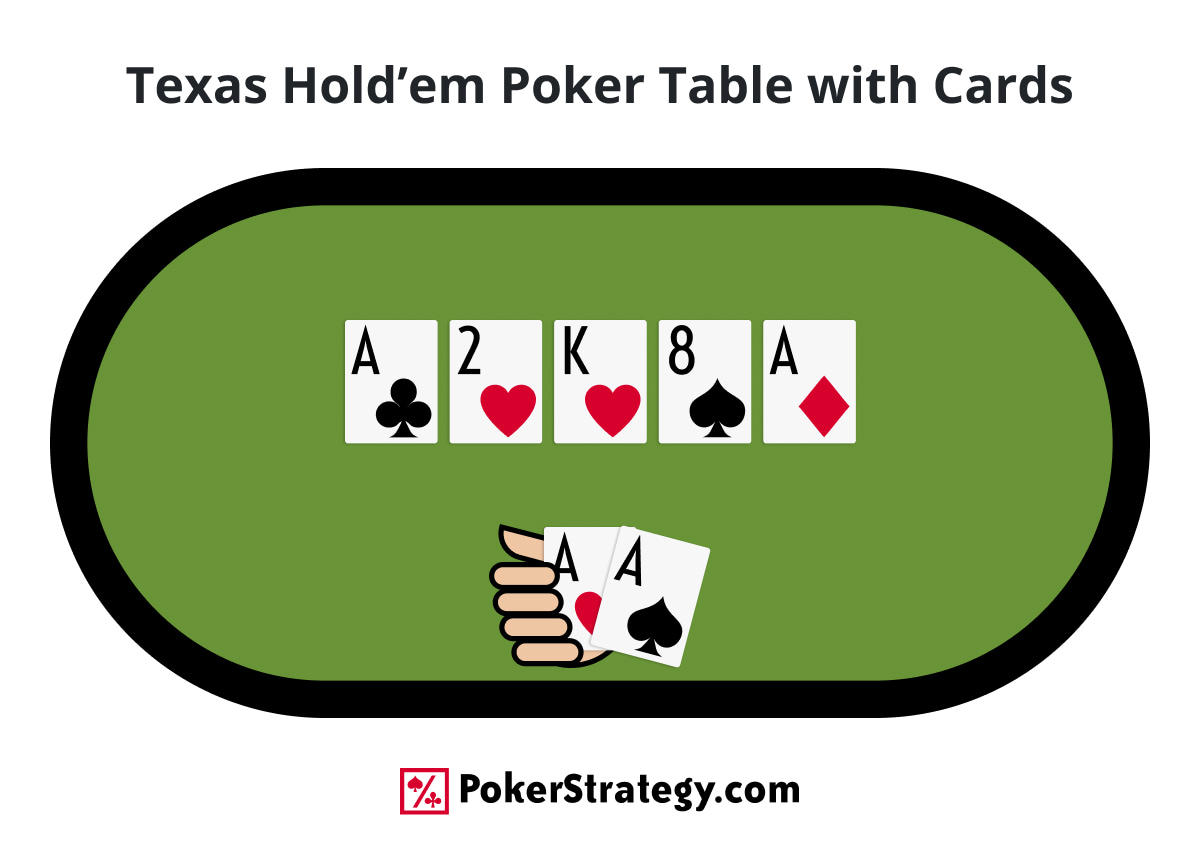
- Setup: Each player gets two hole cards. Five community cards are dealt in stages.
- Betting rounds: Pre-flop, flop (3 cards), turn (1 card), river (1 card).
- Why it matters: Texas Hold’em is the headline event at the WSOP and dominates online poker sites.
Omaha Poker
Omaha is another popular community card game. Each player gets four hole cards and must use exactly two of them plus three community cards. Although Omaha often plays as Pot Limit, it still creates large pots and action-heavy games.
Five Card Draw
One of the simplest forms of poker, and often what beginners picture first. Players are dealt five cards, bet, then can discard and draw new ones before a final round of betting. Still popular in home games.
Poker Rules & Gameplay Basics
After learning the rankings and variants, you need to understand how those hands are used within the rules of the game. Every poker variant has slight differences, but the basics are virtually the same across the board – and these fundamentals provide the foundation of any legitimate poker training course.
These are the essential poker rules for beginners that apply across most popular variants, whether you’re playing live or online. Unlike most card games, poker uses forced bets to create action and ensure that there is always something at stake.
The two main types are blinds and antes:
- Blinds: Before the cards are dealt, the two players to the left of the dealer button must post forced bets. The first player posts the small blind, and the next player contributes the big blind, usually twice the value of the small blind. Blinds ensure that all hands begin with chips in the pot, inviting competition.
- Antes: Common in tournaments and some cash games, an ante is a small bet that every player at the table contributes before the hand begins. Unlike blinds, which are posted by only two players, antes are contributed by all players and build the pot more quickly, creating more action and making every hand more contested.
After the blinds and antes are posted, the hand moves through several betting rounds.
Players can choose between several actions: check, bet, call, raise, or fold (although the action sometimes depends on what previous players have chosen). If two or more players remain at the end, there is a showdown, where hands are revealed, and the best five-card hand wins the pot.
How to Play Poker
If you want to learn how to play poker, the basic flow is simple: deal the cards, post blinds or antes, complete betting rounds, and award the pot to the best five-card hand.
In most popular variants, each player receives private cards, followed by structured betting rounds. The game ends either when one player remains after everyone else folds, or at showdown when the strongest hand wins.
If you’re learning how to deal poker at home, cards are distributed clockwise starting with the player to the left of the dealer button, and the button rotates one seat after every hand.
Betting in Poker
Betting is at the heart of poker.
Understanding how the betting structure works is the foundation of winning at the table, as every hand involves players choosing to bet chips, protect their stack, or build the pot. Once the antes and blinds are paid as described above, the first betting round begins with the player to the left of the big blind.
On each turn, players can take one of the following actions:
- Check: Pass the action without betting when no one has placed a wager in the current round. It allows you to stay in the hand without committing more chips, but you’ll face another decision if another player bets after you check.
- Bet: Put chips into the pot when no wager has yet been made during that round. It sets the price for other players to continue and can be used both for value with strong hands and as a bluff.
- Call: Match the current bet or raise. A call allows you to stay in the hand without increasing the stakes further.
- Raise: Increase the size of an existing bet. It pressures opponents, extracts more value with strong hands, or creates an impression that you’re holding strength when bluffing.
- Fold: Conceding your cards and forgoing all right to the pot that is in progress. You are out of the hand once you fold and cannot act again until the next hand is dealt.
Betting rounds repeat after each new community card (in Texas Hold’em and Omaha) or after each draw (in draw poker). With each round, players incorporate new strategies, either by taking advantage of a strong hand, by bluffing with a bad one, or by carefully controlling the amount of the pot.
Betting Limits
Different poker formats use different betting rules:
- No-Limit: Bet any amount at any time (common in Texas Hold’em).
- Pot-Limit: Max bet equals the size of the pot (popular in Omaha).
- Fixed-Limit: Bets and raises are capped to set amounts.
Example:
You’re on the button in a $1/$2 game. The small blind posts $1, the big blind posts $2. Action folds to you.
- No-Limit: You can raise to any amount, from $4 (minimum raise) up to your entire stack. You decide to raise to $15.
- Pot-Limit: The pot contains $3 ($1 + $2). You can raise up to $7 total ($2 to call + $5 maximum raise, matching the pot after your call). You raise to $7.
- Fixed-Limit: In a $2/$4 game, all pre-flop bets and raises are fixed at $2 increments. You can only raise to $4 (one $2 bet + one $2 raise).
Poker in Casinos & Online
Whether you play Draw, Omaha, or Hold’em, the setting greatly shapes the experience.
Poker is usually played in two main environments:
- Live casinos: Games are dealt at physical tables with real dealers and chips. The atmosphere is social, and players rely on tells and table talk.
- Online poker: Played on sites and poker apps. It’s faster, offers more variants, and has tools like hand histories.
Both offer cash games (where you can play as long as you want) and tournaments (structured with increasing blinds over time).
Basic Poker Strategies for Beginners
Once you learn the rules and where to play, the next step is to understand some simple strategies. Poker is a mix of skill and chance, and while outcomes can never be guaranteed, focusing on the fundamentals will help you make better decisions at the tables.
If you’re wondering how to win poker consistently, the key is disciplined hand selection, strong position awareness, and smart betting decisions over the long run.
- Starting hand selection: You shouldn’t play every hand. High-value hands such as AA, KK, QQ, and AK win more frequently.
- Position: It is powerful to be “on the button” (the most recent to act) as you watch others acting first, prior to your own action.
- Bluffing basics: You should never bluff every single hand. Bluff when your story makes sense, and your opponent is capable of folding strong hands.
- Bankroll management: Only risk money you can afford to lose. Choose limits that keep you comfortable, so you can focus on making good decisions rather than worrying about the stakes.
Why Poker Remains Popular
Poker differs from games like roulette or slots, where outcomes depend largely on luck. In poker, chance plays a role, but your choices and strategies directly influence the results. Players enjoy the combination of competition, psychology, and the opportunity to win life-changing prizes.
The social side also matters: whether playing at a casino, in a home game, or on poker sites, the game creates shared stories and rivalries.