

Pot Odds
In This Guide
Quick facts by PokerStrategy
- Pot odds are the ratio between the total size of the pot and the cost of calling a bet.
- To use pot odds, convert the ratio to a percentage and compare it to your equity in the hand.
- Pot odds are most useful with drawing hands on the flop and turn, or when bluff-catching on the river.
- Always factor in implied odds, stack sizes, and player tendencies alongside pot odds when making decisions.
What Are Pot Odds in Poker?
Pot odds are the ratio between the total size of the pot and the cost of calling a bet.
Understanding pot odds gives you a mathematical framework for deciding whether a call is profitable — comparing the price you’re getting from the pot against your chances of winning the hand.
The Pot Odds Formula: Pot Odds = Total Pot ÷ Cost of Call
For example, if there’s $100 in the pot and your opponent bets $100, the total pot is $200 and it costs $100 to call — giving you 2:1 pot odds.
Converting Pot Odds to a Percentage: Pot Odds % = 100 ÷ (Total Pot ÷ Cost of Call + 1)
Using the same example: 100 ÷ 3 = 33.3%. This means you need to win the hand more than 33.3% of the time for the call to be profitable.
Pot odds are most useful when deciding whether to call with drawing hands — such as flush or straight draws — or when considering a bluff-catch on the river. The rest of this guide covers how to calculate pot odds, when to use them, and how to factor in related concepts like implied odds and expected value.
How Poker Odds Work
By comparing the total size of the pot with the amount that it costs to call, poker pot odds provide a mathematical way of figuring out whether or not a call is profitable in the long term.
To know whether a call is profitable, you need the other part of the puzzle, which is to compare the pot odds with your chances of winning the hand, known as your equity in the pot.
In the case of calling with draws, your equity can be calculated based on the number of outs that you can hit that will complete your draw. You can then compare this to your pot odds to see if the price is right.
How to Calculate Pot Odds
Pot odds are a key tool for making sound decisions in poker. Below, you will discover two easy ways to express pot odds: as a simple ratio and as a percentage you can directly compare to your hand’s equity.
Calculating Pot Odds as a Ratio
The easiest way to calculate pot odds is as a ratio.
To do this, divide the Total Pot by the Bet Size. For clarity, Total Pot is the amount in the pot after a bet has been made.
Pot odds = Total Pot: Bet Size
For example, if the pot is $100 before the bet and you are faced with a bet of $100, the Total Pot is $200, and the Bet Size is $100.
In this example, our pot odds are:
$200:$100 = 200:100
Simplified to 2:1 pot odds
Calculating Pot Odds as a Percentage
When it comes to using pot odds in poker, you’ll often find it useful to convert the ratio into a percentage. This will allow you to directly compare your pot odds with your equity in the hand.
To convert your pot odds into a percentage, add the two numbers of the ratio together and then divide 100 by the total, like so:
X : Y
X + Y = Z
100/Z = pot odds %
So, running with our 2:1 pot odds example from above, here’s the formula:
2:1
2 + 1 = 3
100/3 = 33.3%
You can also use a pot odds calculator to check your work as you practice, though the goal is to internalize these calculations so you can apply them in real time.
Pot Odds Chart by Draw Type
| Draw Type | Outs | Flop Equity | Turn Equity | Min. Pot Odds to Call (Flop) |
|---|---|---|---|---|
| Straight + Flush Combo Draw | 15 | ~54% | ~32% | ~1:1 |
| Flush Draw + Overcard | 12 | ~45% | ~26% | 1.2:1 |
| Flush draw | 9 | ~35% | ~19% | 2:1 |
| Open-ended straight draw | 8 | ~31.5% | ~17% | 2.5:1 |
| Two overcards | 6 | ~24% | ~13% | 3:1 |
| Gutshot straight draw | 4 | ~16.5% | ~8.5% | 5:1 |
Using Pot Odds to Improve Your Poker Game
You can use pot odds to make well-informed, mathematical decisions when making calls.
If your equity in the hand is higher than the pot odds, you can profitably call. If your equity in the hand is lower than the pot odds, you can’t profitably call. Unless there is justification to do otherwise, the pot odds suggest that you should fold.
Running with the example above, if you’re facing a bet that lays you 2:1 pot odds, you’ll need to win the pot more than one-third of the time to make the call. Or, as a percentage, you’ll need more than 33.3% equity against your opponent’s range.
Putting these concepts into practice at the tables is the fastest way to internalize them — some of the softest poker sites make it easier to apply these concepts and learn as you go, with looser competition giving you more opportunities to practice pot odds decisions in real time.
Rule of 4 and 2 to Calculate Outs in Poker
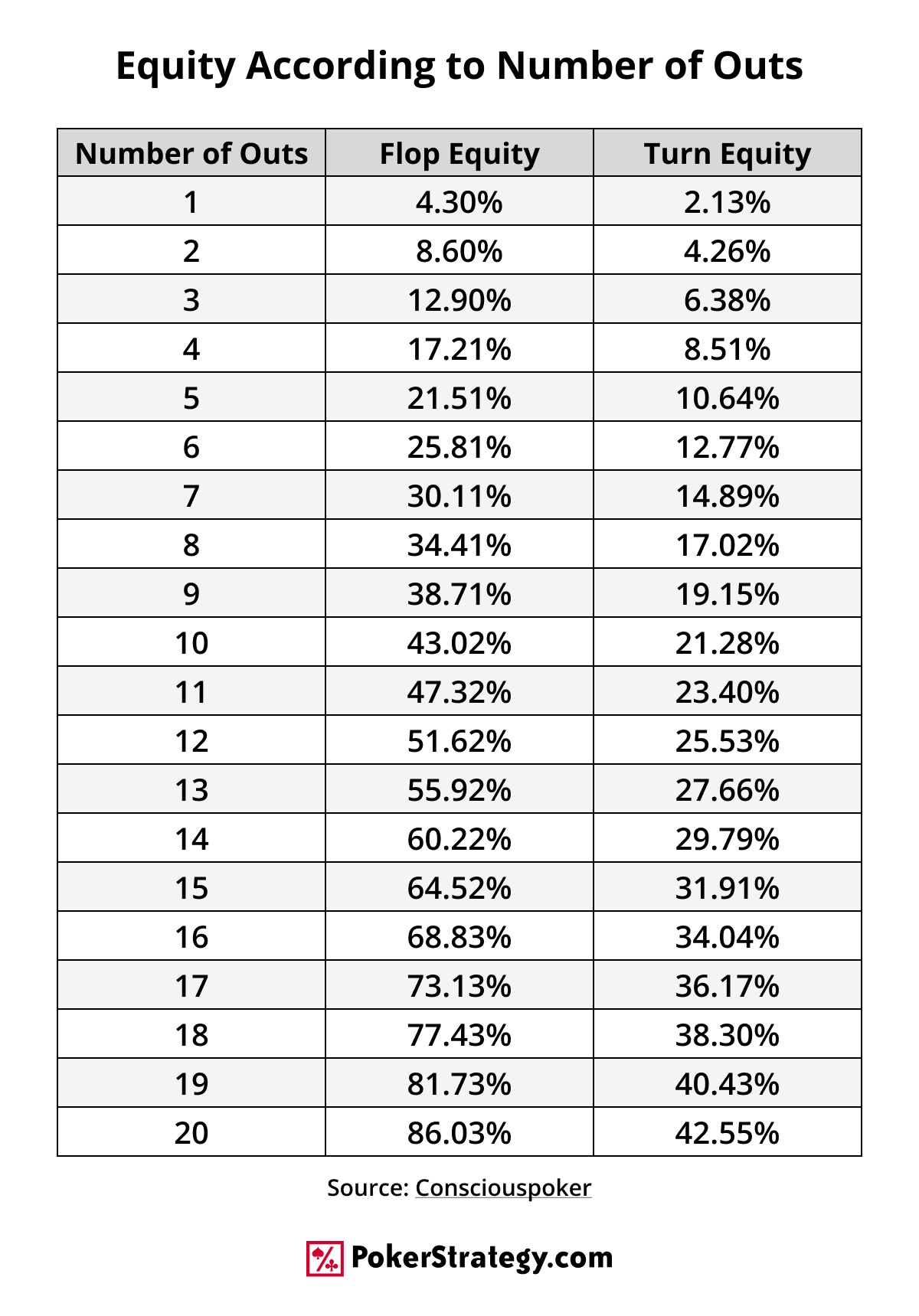
To find out your equity in a hand when you have draws, you can use a simple method called the Rule of 4 and 2. This method helps you estimate your equity based on your outs.
Start by counting the number of outs. Then, multiply this number by 4 if you’re facing a flop bet or 2 if you’re facing a turn bet:
Equity on flop = number of outs x 4
Equity on turn = number of outs x 2
This is not a completely accurate formula. It also assumes that you will always win the pot at showdown when you hit your draw and always lose the pot at showdown when you miss.
Pot Odds for Flush Draw
If you have a flush draw and need to hit one card of a particular suit to complete your draw, you have 9 outs (13 cards of that suit in the deck, with four already in your hand or on the board, leaving a possible 9 outs).
Using the Rule of 4 and 2, multiply your outs according to the street of betting. If you’re facing a flop bet, then your rough equity is 9 x 4 = 36%. So, if the pot odds are less than 36%, you can profitably call the bet.
If facing the same size bet on the turn, your rough equity would be 9 x 2 = 18%. In this case, you would have nowhere near the right price to call, given the pot odds.
Pot Odds for Straight Draw
An up-and-down straight draw has 8 outs; four cards at the top end and four cards at the bottom end. Using the Rule of 4 and 2, you have around 32% equity (8 x 4) on the flop and need pot odds of less than 32% to profitably call.
With a gutshot straight draw, you only have 4 outs, which gives you around 16% equity. This is rarely enough to call a bet. A backdoor straight draw has even less equity at a meagre 4%.
Pot Odds When Facing River Bets
You can also use pot odds when facing the river bet. In this case, your equity depends on how often your opponent is bluffing.
On the river, it’s usually better to check to showdown with a medium strength hand, so your opponent’s range will often be polarized when they bet. Either they have a very strong hand that beats you, or they are bluffing to avoid losing at showdown with a weak hand.
Assuming your hand beats all of your opponents’ bluffs and loses to all of their value hands, you can use pot odds to decide whether to make the call.
Here’s how to use pot odds on the river:
Your opponent makes a pot-sized bet of $100 into a $100 pot, laying you 2:1 pot odds, or 33.3%. If they are bluffing more than 33.3% of the time, you can profitably make the call.
Pot Odds Cheat Sheet
Here’s a cheat sheet for determining the equity required based on the bet size and pot odds.
These are the most common bet sizes that you’ll face:
| Size of Bet | Pot Odds | Equity Needed to Call |
|---|---|---|
| Pot-sized bet | 2:1 | 33% |
| ¾ pot bet | 2.5:1 | 28.6% |
| ½ pot bet | 3:1 | 25% |
| ⅓ pot bet | 4:1 | 20% |
| ¼ pot bet | 5:1 | 17% |
Pot Odds & Expected Value
Expected value refers to the amount you can expect to win or lose in the long run by making a particular move. It takes into account pot odds, equity, and other concepts such as fold equity and implied odds.
Expected value is a complex calculation that aims to account for all the factors and scenarios that can occur in a poker hand, assigning probabilities and chip or cash values to each outcome to see if a play is profitable.
In simple terms:
- If your equity is greater than the pot odds, the call has positive expected value (+EV).
- If your equity is lower, it’s a negative EV (-EV) play.
By consistently making +EV decisions, you’ll improve your win rate and long-term results at the table.
Pot Odds Limitations & Considerations
Once you get the hang of it, it’s not too difficult to use pot odds when it comes to drawing hands or calling river bets. However, there are major limitations if you focus only on pot odds and neglect other factors that could influence how +/-EV a particular spot is:
- Implied odds: Implied odds are the theoretical amount that you are likely to win if your hand improves. If you complete your flush on the turn, for example, you may be able to win your opponent’s entire stack by the river. This can influence decisions, allowing you to call with slightly worse pot odds than your equity alone implies.
- Reverse implied odds: On the opposite end of the spectrum, your weaker draws could have reverse implied odds. If you hit a weak draw, for example, there’s a chance an opponent could hit a higher hand and take all of your chips. This can sometimes give you a reason to fold a hand even if you have the right pot odds to call.
- Fold equity: Fold equity is the amount you can gain by forcing your opponent to fold. You only have fold equity when you take an aggressive action, such as betting or raising. Very often, drawing hands won’t have the right equity to call bets. Even backdoor draws, though, can become profitable semi-bluffs when you account for the fold equity gained by raising.
- Other factors: When playing a poker hand, consider all relevant factors. This includes position, stack sizes, player tendencies, and other relevant factors. For example, it might be more profitable to call against a loose cannon with deep stacks because they are more likely to pay you off when you hit (good implied odds). Or, you may have position over a tight player, giving you a chance to raise your draw as a bluff (gain fold equity).
Don’t think about pot odds in a vacuum. Use them as one factor when making your decisions in poker.