

Quick facts by PokerStrategy
- A short stack in poker is a stack that is relatively short compared to the blinds.
- The term can also be used to refer to being relatively short compared with other stacks in the table or tournament.
- A stack of 20 big blinds or less is considered short in many tournament structures.
- Stack size has a direct impact on poker strategy.
- Short stack poker strategy revolves around pushing or folding.
What Is a Short Stack in Poker?
A short stack in poker is defined most commonly as a chip stack that is relatively short compared to either the blinds, opponents’ stacks, or the maximum buy-in for cash games.
The short stack poker meaning is usually based on the size of the big blinds. Anything less than 20 big blinds can be considered a short stack, while the critical zone for short stacks in tournaments is 5-15 big blinds.
With a short stack in poker, your starting hand ranges and post-flop betting lines will be severely restricted. Never fear, though. Using a solid short-stack strategy, you’ve got a good chance to survive and rebuild.
Why Stack Size Matters in Poker
Stack sizes should directly impact your poker strategy. If you have a short stack of 20 big blinds, you won’t be able to take complex betting lines over the course of multiple streets, and you shouldn’t 3-bet / fold pre-flop.
Here are some short stack poker examples to illustrate:
Here’s a short stack in poker explained with reference to some simple examples.
You have KJo in middle position in a full-ring tournament, not yet in the money. With a 40 big blind stack, you are not yet short-stacked and can afford to raise as a standard open and fold if someone 3-bets. Even if someone calls, you have the stack to comfortably c-bet on a number of boards. You also have decent equity when you connect with the top pair against weaker ranges.
Imagine the same scenario with a 20 big blind stack. Raise-folding would now cost you at least 10 percent of your stack. If you are called, it would be risky to make a continuation bet since stronger broadways often dominate you. Plus, your room to maneuver post-flop goes down considerably.
With an even shorter stack of 10 big blinds or less, you are reduced to either shoving or folding pre-flop, with no room at all for post-flop play. In this case, KJo is strong enough to go all in from middle position.
Stack sizes impact opening ranges, continuation bets, bluff frequencies, implied odds, and your ability to apply pressure over multiple streets. This is especially important in fast-structured tournaments, where blinds go up quickly. Players in the UK can find these formats on many of the best poker sites in the UK.
How to Play with a Short Stack
Given that you’ll have fewer betting options and less potential for post-flop play, short-stack poker strategy is based around selective pre-flop aggression.
Your key goals when you have a short stack are:
- Doubling up – Primarily, you should be looking for opportunities to move all-in with strong hands that have decent equity against your opponent’s calling range. You’re looking to double up to restore your stack to a more playable size.
- Stealing pots pre-flop – As well as shoving with value hands, you can also move all-in with a wide range from late position to steal the blinds. This will give your stack a much-needed boost and allow you to survive another orbit.
- Avoid bleeding chips – Your stack is already short, so you don’t want to slowly lose more chips by limping or raising without a plan. Short-stack poker play, especially when down to 10bbs or so, should consist of simple push-fold moves.
- Chip accumulation or survival – Most of the time, you’ll be looking to use your short stack to gain chips by doubling or stealing. The exception to this is the bubble or major pay jumps in a tournament. In this case, survival becomes the priority.
Short Stack Strategy by Stack Depth
In poker, a short stack is not optimal for more complex lines either pre-flop or post-flop, but not all is lost. You should find plenty of profitable spots to steal the pot or potentially double up.
Here’s a quick short-stack poker strategy guide for playing various short-stack depths:
20-25 Big Blinds – Fairly Short Stack
You have a fairly short stack, so post-flop play is restricted, and speculative hands become less valuable. Avoid set mining or calling down bets with suited connectors unless defending the big blind.
Raise-folding should be done with a tighter range than usual unless the situation is favorable, as it will cost a larger proportion of your stack. Consider tightening up your pre-flop starting hand range so that you don’t end up committing chips with marginal hands.
A 20 big blind stack is a great size for 3-betting all in. Look for spots to 3-bet shove for value, as well as opportunities to 3-bet bluff shove against loose late position raises.
15-20 Big Blinds – Short Stack
By the time you are down to 15-20 big blinds, you are definitely too short-stacked to take complex betting lines post-flop. You’re almost entirely constricted to pre-flop strategy, which should involve open-shoving or reshoving in a lot of suitable spots
This is the sweet spot for 3-betting all in. If your opponent folds, you’ll take down a pot worth around five big blinds, adding 25-30 percent to your stack. A single double up with a 15-20 big blind stack will also put you back in a healthy position.
10-15 Big Blinds – Very Short Stack
With a very short stack of 10-15 big blinds, you’re looking for any opportunity to open-shove with a decent amount of equity to steal the blinds or double up your stack.
5-10 Big Blinds – Extremely Short Stack
If your stack falls below the 10 big blind mark, you are really very short. In a poker tournament, the blinds will soon go up, and your stack will take yet another hit.
With 5-10 big blinds, you need to be shoving wide from late position to steal blinds. Try to make your move before the blinds hit you again. Pick a hand that plays well against potential big blind calling ranges, then shove and hope for the best.
Short-Stack Push-Fold Strategy Explained
With a short stack of 10 big blinds or less, you can only profitably shove or fold. There’s no point raise-calling, as any raise commits you to the pot and so is effectively an all-in. Shoving generates maximum fold equity, while doing the same with your value hands gives you a chance to double up.
The dead money from the blinds and antes inflates the pot, so you’ll win around 2.5 big blinds from a steal while only risking 10 big blinds, a gain of 25 percent. This makes it profitable to shove very wide from a late position.
Push-fold short stack strategy is relatively easy to learn because your only decision is whether or not to shove. You can study push-fold charts to learn GTO short-stack poker ranges for each position and stack size, given certain assumptions about the stage of play (these ranges change when ICM takes more effect around the bubble and ITM phases).
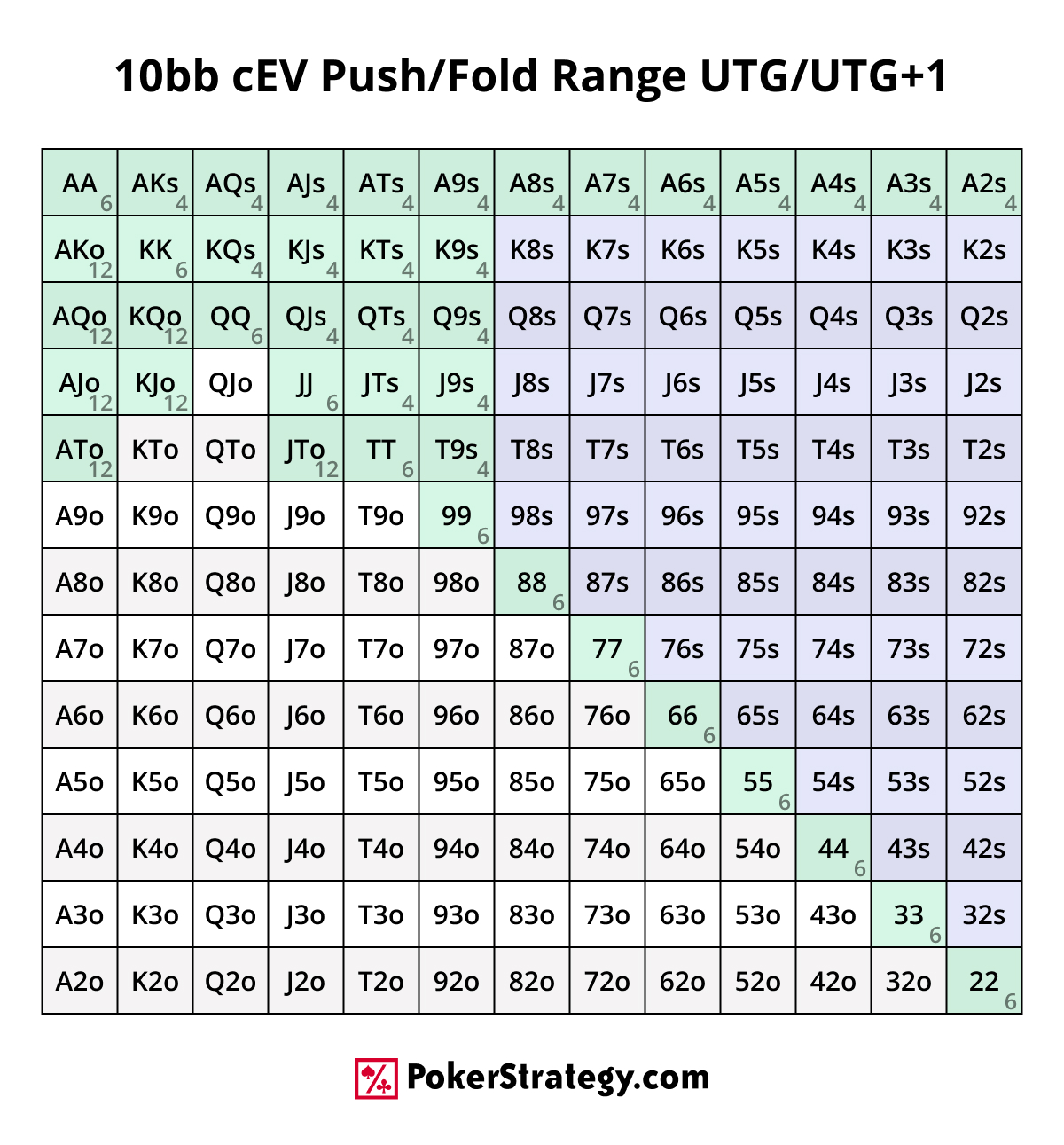
Push-Fold Chart for 10 Big Blind Stack
Here is a simple example push-fold chart for 10 big blind stacks based on position. Keep in mind that these are GTO chip EV short stack poker ranges and should be adapted based on your opponents. For example, if your opponent is overfolding in the big blind, you can shove even wider from the button.
Short Stack Strategy in Tournaments
Having a short stack in a poker tournament is a much bigger problem than it is in a cash game for a few reasons:
- You need to run deep in a tournament to lock up a big score, so having a short stack means you’ve got a long way to go to recover.
- Losing all of your chips in a poker tournament can often mean you are out of the game, so a short stack can represent your last stand.
- The blinds increase at regular intervals in a poker tournament, which further reduces your relative stack size and puts you at greater risk.
Given these factors, you can’t afford to wait around for a premium hand when you have a short stack in poker tournaments.
Effectively, you’re in a race against the blinds and need to keep accumulating chips so that you don’t become critically short-stacked. That’s why the push-fold strategy is so important in poker tournaments.
Short Stack Strategy in Cash Games
Having a short stack in cash games is less of a disaster. For starters, the blinds remain the same throughout the game, so you won’t have the extra pressure from blind jumps.
More importantly, as long as you have the bankroll, you can reload when you have a short stack in a cash game. Nobody is forcing you to sit there trying to claw it back with a five big blind stack. You can simply add more chips.
Suppose you are playing with a short stack in cash games. In that case, it will nearly always be out of choice, either because you don’t want to risk buying in for the maximum or because you are using short-stack poker strategy to your advantage on an aggressive table to double up.
Common Mistakes with Short Stack Poker Play
Short stack play is the simplest type of poker strategy you can get, as most decisions are reduced to either shoving or folding. Still, there are plenty of pitfalls that can ruin your chances of spinning your stack back up.
Here are the most common mistakes with short-stack poker play:
- Limping or min-raising – Limping gives you no fold equity and will often result in you playing multiway pots post-flop, which is the worst situation to put yourself in with a short stack. Likewise, min-raising can result in difficult post-flop situations, and raise-folding is costly.
- Flat calling raises – You should rarely flat call opponents’ raises with a short stack. Again, this is a waste of what few chips you have, as you’ll be forced to fold when you miss the flop and don’t have the implied odds to continue with speculative hands. When faced with a raise, either fold or re-shove pretty much your entire range. An important exception to this is defending in the big blind, when you often still have the price to continue with a wide range and see a flop.
- Missing shoves – Failing to recognize the value of fold equity and missing shove spots from late position is a significant mistake. As a short-stack player, you need to take the most profitable shove spots to keep growing your stack and stay ahead of the blinds.
- Shoving light from early position – Shoving from early position gives you six, seven, or more players to get through. This drastically reduces your fold equity, as it’s much more likely someone will wake up with a hand. Tighten up from an early position with a short stack, unless you absolutely can’t take another hit from the blinds.
- Ignoring ICM – Most of the time, your main goal with a short stack should be chip accumulation. At certain key moments in tournaments, such as the bubble or pay jumps, survival should be a priority. Shoving incorrectly due to ICM can cost you cash.
Tips for Mastering Short Stack Poker
Here are some quick, short-stack poker tips to take away and use at the tables:
- Understand your stack size – Always think about your stack size relative to the blinds, and be aware if you are getting short. Start looking for reshove spots with 20 big blinds and open-shoves with 10-15 big blinds.
- Play tight aggressive – Choose your spots carefully and then commit to them. Don’t limp, raise-fold, or flat call raises with speculative hands to see flops. Stick to a push-fold short stack strategy.
- Steal blinds often – As well as shoving your value hands to double up, you should be looking for opportunities to steal blinds whenever possible to add to your stack and stay ahead of blind jumps.
- Study push-fold charts – Short stack poker strategy is relatively simple because decisions are reduced to shoving or folding.
- Make adjustments – You can adjust your short-stack poker ranges according to your opponents. FShove wider from late position if the big blind overfolds, or loosen your value range if someone is calling too light.
Frequently Asked Questions
How many big blinds is considered a short stack?
A short stack is considered to be around 20 big blinds or less,as this is when your stack becomes way less playable. With 10 big blinds or less, you have a very short stack and need to start shoving.
What is the best short-stack poker strategy?
The best short stack poker strategy is to simplify your play by either folding, or open-shoving or reshoving against raises with both value hands and bluffs. This is known as a push-fold strategy.
Is short-stack poker strategy different in tournaments and cash games?
In tournaments, you’ll need to actively shove to steal pots with a short stack to increase your stack and stay ahead of blind increases. In cash games, it’s possible to reload with more chips.
What are the best hands for a short stack?
Premium hands are the best with a short stack, as they give you a good chance to double up, while speculative hands go down in value. Hands with blockers like aces or kings are useful for shoving from late position.
Should you bluff when short-stacked in poker?
With a short stack, you don’t have the stack depth to raise light or attempt too many post-flop bluffs. However, you can shove light from a late position to steal pots, which is a form of bluffing.
How to recover from a short stack in poker?
Eventually, you’ll want to double up your short stack by getting your chips in the middle with decent equity. Until this happens, you can continue to steal blinds to accumulate chips and stay ahead of the blinds.